
Twenty Years of Building What Works: Celebrating Julie Warnecke and Found Search Marketing

Updated: Aug 3

Twenty years ago, Julie Warnecke left Google, returned to Indiana, and founded Found Search Marketing with deep expertise, a promising hypothesis, and the willingness to learn the business side of entrepreneurship as she went.
What followed was not simply the growth of another marketing agency. Julie built a company around a clear belief: clients deserve direct access to experienced practitioners who understand their businesses, take responsibility for results, and care more about measurable outcomes than presentations, titles, or vanity metrics.
Today, Found Search Marketing has grown from one client into a team of more than 50 employees working across 12 states. In 2025 alone, Found managed more than $210 million in media and generated more than one million leads for its clients.
Julie’s impact, however, extends far beyond the company she founded.
Julie has been involved with The Startup Ladies since 2015 and was the very first speaker at Startup Study Hall. Over the years, she has hosted The Startup Ladies many times, shared her expertise with our founders, provided thoughtful advice during especially challenging situations, and consistently supported our mission of helping women build and fund scalable companies.

She has also been an important advisor and friend to me personally. Julie is someone I can trust to be candid, thoughtful, and focused on what will actually produce results.
As we celebrate the 20th anniversary of Found Search Marketing, we invited Julie to reflect on the experiences, decisions, challenges, and relationships that have shaped her company.
For founders and business leaders, her answers offer something especially valuable: an honest look at how expertise becomes a business, how trust becomes a growth strategy, how a company scales without losing what makes it special, and why waiting to feel completely ready can cost you years of progress.
1. You started your digital marketing career at Google during a very early era of AdWords. What did that experience teach you about technology, customer behavior, and the speed of change?
It taught me there was no manual; we were writing it. AdWords was split between AdWords Select and AdWords Premium, and my team built the first advertiser support function for self-service advertisers. People came to Google, entered a credit card, their keywords, and their website, and launched ads. We approved the ads and taught advertisers how to write better copy. We were inventing the playbook in real time.
That taught me three things. Technology moves faster than best practices. Customers will tell you what works if you watch what they actually do. And the speed of change isn’t a phase you wait out; it’s the permanent condition of this industry.
2. Twenty years ago, you left Google, returned to Indiana, and started your own agency. What gave you the confidence to make that leap?
I’m not sure it was confidence so much as clarity. I’d been inside the product that was reshaping how the internet makes money, and I understood it in a way very few people outside Google did at the time. Day one was a referral, a documentary film company in New York, and I set up at my condo and taught myself the rest: what to charge, how to build reports, how to run strategy sessions. Not all of it was pretty; my first invoices would not have won any awards. But knowing the craft cold gave me permission to learn the business side on the fly.
3. You’ve said you started with a hypothesis, not a formal business plan. What was the hypothesis, and when did you realize it was working?
The hypothesis was that clients would pay for outcomes delivered by actual practitioners instead of the decorative agency experience: the deck, the titles, the lunch theater. I walked into pitch meetings without a deck and dressed down on purpose so prospects could see that the people doing the work were the people in the room.
I knew it was working when ITT Tech gave us one project off a cold call, we knocked it out of the park, and Found Search Marketing became their paid media AOR. Performance closed that deal, not polish.
4. Looking back, what problem were you really trying to solve when you launched Found Search Marketing?
The translation layer. At traditional agencies there’s a handoff between the people who sell the work and the people who do it, and everything degrades in that handoff: strategy, accountability, speed. I wanted to remove it entirely. No junior account manager standing between the strategist and the client. That’s still the problem Found solves, and it’s a big part of why clients stay for a decade or more.

5. Your work is deeply tied to outcomes. How do you define success for your clients, and how has that changed over the last 20 years?
In 2025, success looked like more than $210 million in managed media and over a million leads generated for clients. But the definition hasn’t changed in 20 years: the client’s bottom line, not campaign vanity metrics.
What has changed is the scope. Twenty years ago it meant well-managed keywords and ad copy. Today it means the whole performance ecosystem: first-party data, audience modeling, media mix, creative, and a clear line of sight from dollars spent to results. The machinery behind it just got a lot bigger.
6. What are some of the biggest business or marketing problems you’ve helped clients solve throughout your career?
The most common one is a client spending real money with no clear line of sight from spend to results, so we rebuild the measurement foundation first. Beyond that, we’ve scaled lead generation for higher ed institutions through two decades of change in that market, helped enterprise brands activate first-party data they were sitting on, and untangled tracking after every major privacy shift. The industries change. The underlying problem, connecting spend to outcomes you can defend, mostly doesn’t.
7. As a business owner, what has been one of the hardest challenges you’ve had to navigate?
Growing without losing the thing that made us different. It’s easy to be an anti-agency at five people; it’s harder at 50-plus employees across 12 states. Every stage of growth invites you to add layers, and every layer is a step toward becoming the kind of agency I left Google to avoid building.
And I’ve gotten it wrong. There were stretches where we added a layer because it felt like what a “real” agency does, and every time, the work got slower and the client felt further away. We pulled the layers back out. Protecting direct access to practitioners while scaling has been a deliberate, ongoing fight, not a one-time decision.
8. When you hit a wall, whether with a client, a team issue, a market shift, or your own energy, what do you do first?
I get closer to the work. Almost every wall looks different once you’re back in the account, the data, or the direct conversation instead of the summary of it. If it’s a client issue, I call the client. If it’s a team issue, I talk to the person, not around them. Distance makes problems abstract, and abstract problems don’t get solved.

9. Found Search Marketing has lasted through major industry shifts, including AI, privacy changes, and evolving ad platforms. How have you trained yourself and your team to stay ahead?
There are sand traps everywhere in paid media. There’s no set-it-and-forget-it, and there never has been, so vigilance is the baseline. We train it by keeping senior people in the work, where the newest and hardest questions show up first.
On AI specifically, we split the team into cohorts this year and pushed every one of them to experiment with Claude and Gemini inside live work, not sandboxes. The point isn’t the tools; it’s the muscle. If I had to guess, the teams building that muscle now will be in a completely different position 18 months from now than the teams that wait.
10. So much of your business has been built through trust and long-term relationships. How have you built the relationships that became your portfolio of clients?
Found started on a referral and grew on referrals, with a few cold calls mixed in. I found ITT Tech through an IBJ article and called their front desk. The pattern in every lasting relationship is the same: do excellent work, be direct about what is and isn’t working, and sit on the same side of the table as the client. Tenure helps too. When clients work with the same senior people for years, trust compounds.
11. What do you think people misunderstand about business development, referrals, and relationship-building?
People treat it as a performance: the pitch, the polish, the networking circuit. Real business development is a byproduct of the work. Referrals don’t come from lunches; they come from a client telling a peer that you made them look good. Invest in delivery first and visibility second. And a referral isn’t a favor you wait for. You can ask for it, and you should.
12. What has leading a team taught you about putting smart people in front of clients and trusting them to deliver?
That trust is the whole model. If you hire the best practitioners and then hide them behind account layers, you’ve wasted the hire. Our senior team is still actively involved in client accounts, which is why several current team members have been with Found for 10-plus years and the leadership team averages 9.3 years of tenure. Keeping smart people in the work and in front of clients is how they keep learning, and it’s why they stay. The fastest way to lose your best people is to promote them out of practice and into internal politics.
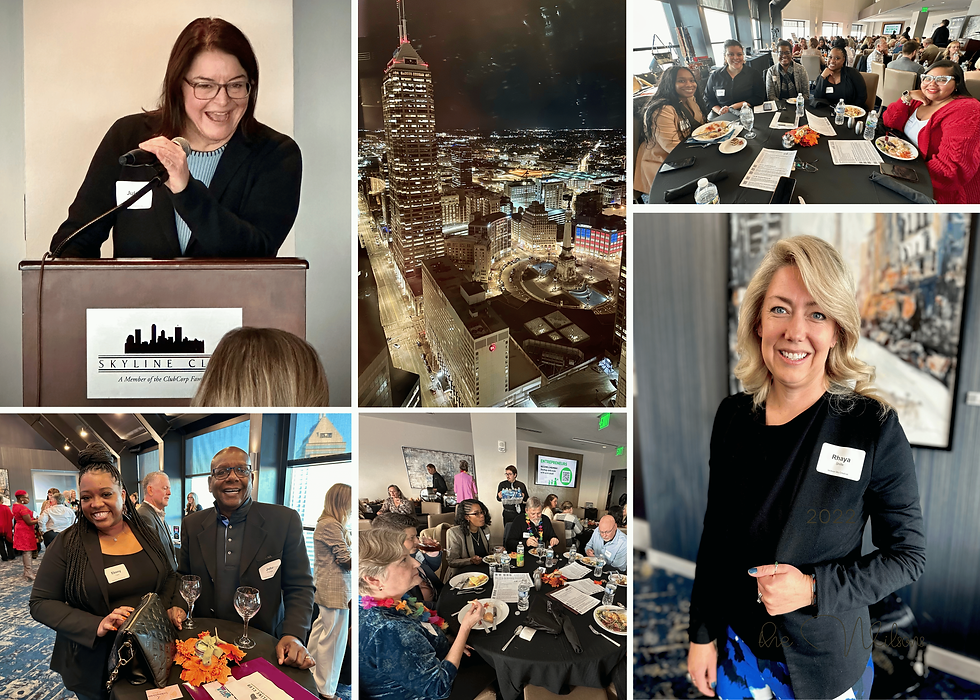
13. You’ve been a longtime board member of The Startup Ladies. What keeps you connected to the mission of helping women founders build and fund scalable companies?
The math keeps me connected. Women own roughly 42 percent of U.S. businesses and receive about 2.3 percent of venture capital. I started Found as a woman founder in 2006, and I know how much of that journey you improvise alone. The Startup Ladies gives founders the structure, education, and investor access I had to piece together myself. Twenty years in, staying on the board is one of the most direct ways I can shorten that path for someone else.
14. What advice would you give to women founders who are excellent at what they do, but are still learning how to sell, ask, negotiate, or be visible?
Selling isn’t a separate skill from your craft; it’s describing your craft to someone who needs it. I cold called ITT Tech’s front desk with no deck and no agency track record, just a clear statement: I know your space, and we should talk. I didn’t feel ready when I made that call. I made it anyway; readiness turned out to be a lagging indicator.
Make the ask plainly, price with confidence, and remember that being visible about your work isn’t bragging. It’s how the right clients find you. Nobody funds or hires the best-kept secret.
15. After 20 years in business, what do you want the next 20 years to look like for you, your company, your clients, and the founders you support?
Honestly, nobody who tells you exactly what marketing looks like in 20 years should be trusted. I ran the first AdWords advertiser support team, and I couldn’t have predicted the last 20. What I can tell you is the direction: as AI makes execution cheap, the value moves to judgment: knowing which direction to take, curating strategy, and stress-testing it in faster cycles than ever before.
For Found, that means the same-size team handling more complex strategies while staying independent and women-owned. For clients, it means faster iteration and better outcomes. And for founders, especially women, I want the next 20 years to include far more of them funded, visible, and building companies that last as long as this one has.
Bonus: What is one lesson from the last 20 years that you hope women founders do not have to learn the hard way?
That you don’t need permission or polish to start. Deep expertise mattered, but the confidence to call a front desk, name a price, and ask for the work isn’t something anyone grants you. Every year spent waiting to feel ready is a year of compounding given away. Ask earlier, charge sooner, and let the work catch up to the ambition. It will.

Experience Julie and Her Team in Action at Startup Study Hall
Julie will return to Startup Study Hall on August 19 to lead Before You Spend Another Dollar on Marketing: Build a Customer Acquisition Test That Proves What Works.
This will be a hands-on session where founders build a practical, measurable customer-acquisition test for their own companies. Rather than simply listening to a presentation, founders will work on their businesses, ask questions, and experience Julie and the Found Search Marketing team in action.
It is rare to have the opportunity not only to meet someone with Julie’s depth of experience, but to watch how her mind works as she listens, asks questions, studies the numbers, and gets to the heart of a business problem. There is a reason The Startup Ladies has kept Julie on our board for more than a decade: she has the experience and judgment to help leaders see what they may be too close to recognize themselves.
As your company grows, you will eventually encounter a marketing challenge that cannot be solved with another quick fix, online course, or round of trial and error. When that happens, you will not have to waste valuable time searching for someone with the right experience and judgment. You will already know Julie and her team personally, understand how they work, and know exactly who to call.
---> REGISTER HERE

Celebrating Julie and the Next 20 Years
There is so much for founders and business leaders to learn from Julie’s first 20 years at Found Search Marketing.
Know your craft deeply. Get close to the work when problems arise. Build relationships by delivering excellent results. Put talented people in positions where they can continue learning and creating value. Protect what makes your company different as you grow. Experiment with new technology before waiting for someone else to create the playbook.
Most importantly, do not confuse readiness with permission.
Julie’s story demonstrates what can happen when expertise is paired with clarity, courage, sound judgment, and a willingness to ask for the opportunity.
The Startup Ladies has benefited tremendously from Julie’s leadership, generosity, honesty, and friendship since 2015. From serving as our first Startup Study Hall speaker to hosting our community, advising our founders, supporting me through difficult situations, and serving on our board, she has invested her time and wisdom in helping other women build companies that last.
Julie, congratulations on 20 extraordinary years of Found Search Marketing.
You have built a remarkable company, an enduring team, a trusted reputation, and a body of work that continues to influence clients, employees, founders, and our entire community.
We are deeply grateful that you have chosen to share so much of that journey with The Startup Ladies.
Here’s to Found Search Marketing’s next 20 years, and to many more women founders becoming funded, visible, and unapologetically ambitious along the way.


Comments